The explosive growth of artificial intelligence (AI) continues to drive unprecedented investment in hyperscale data centers. In response to increasing scrutiny over water consumption, many operators have embraced advanced cooling technologies, including closed-loop and reclaimed water systems designed to significantly reduce freshwater demand. While these technologies represent an important step toward more sustainable operations, recent events demonstrate that water-related risk extends well beyond the volume of water a facility consumes.
Recent contamination incidents in Wyoming and Oregon involving allegations that data center cooling systems contributed to downstream water-quality concerns, together with renewed attention to cooling-tower risks following a Legionnaires' disease outbreak in New York City, demonstrate that poor cooling-water management can create significant environmental, public-health, operational, and financial consequences. Collectively, these developments signal a shift in regulatory and community scrutiny from the volume of water data centers consume to how water is managed throughout its lifecycle, including microbial control, chemical treatment, maintenance activities, wastewater discharges, water-quality impacts associated with use of reclaimed water, and interactions with municipal infrastructure.
The Problem of Water Availability
Water usage, water availability, and water quality are rapidly emerging as the next critical climate risk focus area for the data center industry. A single large hyperscale data center can consume several hundred thousand to more than a million gallons of water per day, primarily for evaporative cooling towers and chiller systems that regulate server temperatures. Water-intensive server operations are compounded by the rise of high-density computing and AI workloads, which generate substantially more heat per rack and, in many facilities, require additional cooling capacity and corresponding water withdrawals.
In February 2026, Harvard Science Review estimated that hyperscale data centers alone are expected to consume up to 33 billion gallons of water annually by 2028. A single large-scale facility can consume up to 5 million gallons of drinking water every single day.1
The U.S. Geological Survey published a National Water Availability Assessment Report in 2025, based on data from 2015 – 2020, that underscores the growing risk that long-term water availability and quality may pose to data center operations. This assessment of relative stress on water availability in four different categories for each hydrologic region within the conterminous United States is particularly stark for the Midwest and Western areas of the United States:
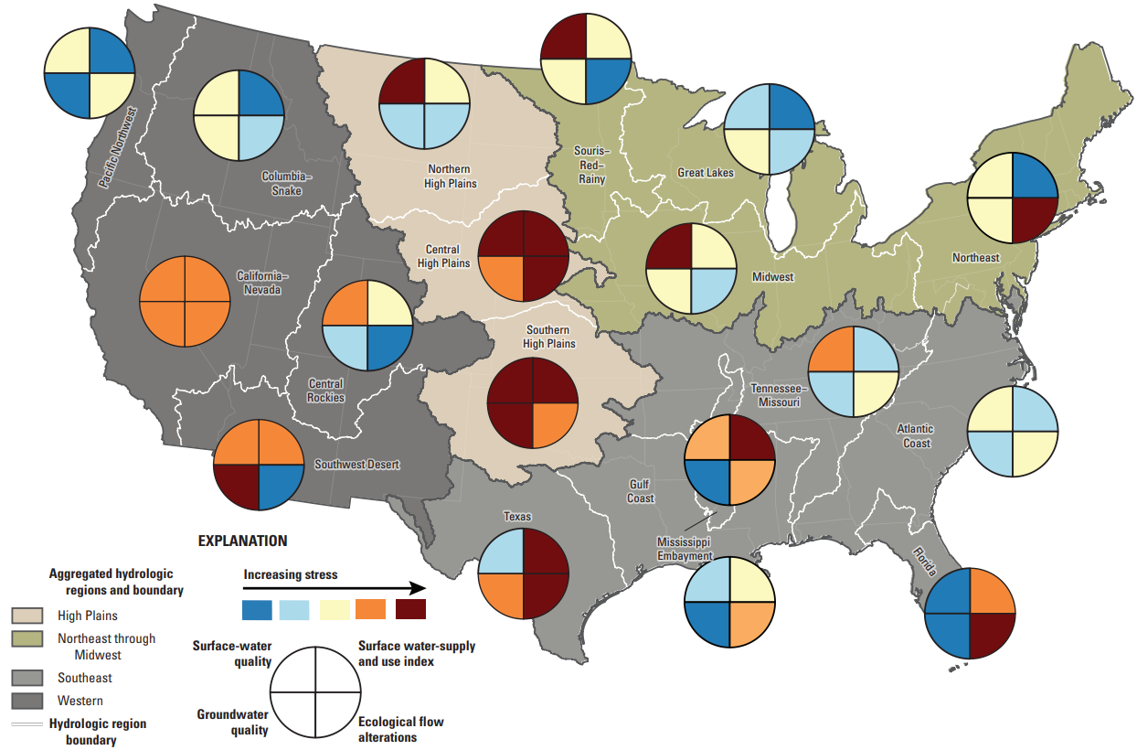
Image Source: 2025 National Water Availability Assessment Report, U.S. Geological Survey
For data center operators considering new facilities or facility expansions in water-stressed regions, permitting considerations related to water use and water discharge, wellhead protection zones, and surface water buffer zones are all areas of increasing regulatory scrutiny. Long-term water availability and quality concerns require planning for backup sources of water and analysis as to whether those sources will require filtration for use in cooling systems.
The pressures on water availability posed by rapid data center growth and extreme weather events make water usage, water availability, and water quality a likely next area of focus for local communities and planning boards, state legislatures, and regulatory agencies.
Potential Solutions: Closed-Loop and Reclaimed Water-Cooling Systems
Leading data center operators are responding by setting ambitious water usage effectiveness targets, with major technology companies committing to become water positive or to significantly reduce water withdrawals per unit of computing capacity over the coming years. Common strategies across the industry include shifting toward air-cooled or free-cooling designs in cooler climates or on cooler days, closing water cycles by treating and reusing process water on-site, sourcing non-potable or reclaimed water for cooling towers, and implementing watershed stewardship programs in collaboration with local utilities and conservation organizations. Companies that invest in closed-loop or reclaimed water-cooling systems, liquid or immersion cooling technologies, and on-site water treatment are often better positioned to address water-availability constraints. While recognizing that at the same time, these technologies require careful attention to water quality, system maintenance, wastewater management, and operational controls to ensure that one category of water-related risk is not exchanged for another.
Proactive water stewardship presents a climate opportunity, serving as a differentiator in a high-water-use industry and generating long-term cost savings. Closed-loop and reclaimed water systems can substantially reduce water withdrawals when compared to traditional cooling approaches. But these approaches are not risk-free. Even highly efficient systems require periodic cleaning, flushing, chemical treatment, and maintenance. These activities can create pathways for biological contaminants, treatment-related constituents, or contaminants already present in reclaimed water sources to become concentrated within cooling systems and ultimately enter wastewater systems if not properly managed.
Hidden Risks of Closed-Loop and Reclaimed Water-Cooling Systems
A recent controversy involving alleged bacterial contamination associated with a cooling-system maintenance operation at a Wyoming data center has intensified public and regulatory attention on the environmental impacts of large-scale computing facilities. Cupriavidus gilardii bacteria, which can be deadly, established itself within the biological treatment processes at both of Cheyenne, Wyoming's municipal water reclamation facilities. The contamination was allegedly the result of a new data center's "fill-and-flush" cooling system cleaning operation system, and the utility's municipal system had to be taken offline for extensive treatment. The water utility banned future discharges from the facility and fined the data center $10,000 for the violations, which the company plans to challenge, according to local news reports.
Another data center company in Oregon recently signed a $20 million settlement for allegedly exacerbating nitrate pollution in the local groundwater from its reclaimed water-cooling systems. The data center used reclaimed, nitrate-loaded wastewater to cool its servers, a practice that allegedly resulted in the concentration of pre-existing nitrate within the water-cooling system before the water was ultimately discharged and land applied to nearby agricultural fields. The company denied the allegations, noting longstanding groundwater-quality issues in the area.
At nearly the same time, public attention in New York City recently focused on a disease outbreak in Manhattan's Upper East Side, renewing concerns regarding cooling towers and the potential consequences of inadequate water-system management. The outbreak prompted widespread cooling-tower testing, remediation efforts, and ongoing regulatory investigation, underscoring the level of scrutiny that can accompany potential Legionella contamination events. Although the New York outbreak did not involve a data center, it serves as a useful reminder that cooling-water infrastructure increasingly sits at the intersection of environmental compliance, public health, operational reliability, and reputational risk. When microbial growth occurs within cooling systems, the resulting consequences can extend far beyond facility operations, drawing scrutiny from health departments, environmental regulators, elected officials, utilities, neighboring communities, and the media.
Taken together, these developments highlight a significant shift in how regulators and communities are evaluating water-related impacts. Historically, public debate surrounding data centers focused primarily on how much water a facility consumes. Increasingly, however, attention is turning to how that water is managed throughout its lifecycle, including cooling-system operation, chemical treatment programs, wastewater discharges, maintenance activities, and interactions with municipal water infrastructure.
Recommended Next Steps
Data center operators should consider water management programs as a core component of enterprise risk management rather than solely an operational or sustainability function. Comprehensive programs should address cooling-system monitoring, microbial control, maintenance protocols, wastewater management, water-quality impacts associated with use of reclaimed water, and coordination with local utilities and public authorities. Particular attention should be devoted to system cleaning and flushing activities, which may present elevated risk if discharge pathways and treatment requirements are not fully understood before maintenance occurs.
Ultimately, the next generation of data center water risk is shifting from questions of water consumption to questions of comprehensive water stewardship. Operators that focus exclusively on reducing water use may still face significant regulatory, operational, public health, and reputational challenges if they do not also address microbial growth, cooling-system management, wastewater obligations, and interactions with municipal infrastructure. The recent Wyoming and Oregon controversies and renewed national attention to cooling towers following the New York City Legionnaires' disease outbreak illustrate a common theme: stakeholders increasingly view water management as an environmental, operational, and public health responsibility rather than merely a sustainability metric. For data center developers and operators, water-efficient technology remains an important part of the solution, but comprehensive water stewardship is rapidly becoming both a regulatory expectation and a business imperative.
If you have questions about these developments or would like to discuss the potential impact on your business, please contact a member of Baker Donelson's Environmental Group or Digital Infrastructure and Data Centers Team.
---
1 https://harvardsciencereview.org/2026/02/28/re-architecting-the-ai-server-the-hidden-water-cost-of-data-centers-part-ii/