Lex Machina's 2026 Employment Litigation Report, released last month, indicates that disability accommodation claims reached a record high in 2025, continuing an upward trend that began in 2021.
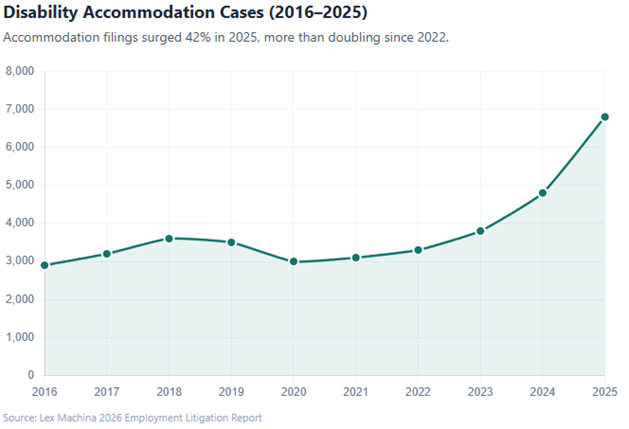
In 2025, plaintiffs filed 6,796 disability accommodation lawsuits, representing an increase of approximately 42 percent from the prior year. Key drivers of this trend include the rollback of remote work policies that were put in place during COVID, a rise in accommodation requests related to mental health conditions, and the continuing impact of long COVID. Recent Equal Employment Opportunity Commission (EEOC) guidance and federal court decisions offer important direction for employers navigating these issues.
Employers in labor-intensive or highly regulated industries – such as health care, manufacturing and logistics, and retail and hospitality – are seeing disproportionate exposure, particularly as they scale back pandemic‑era flexibility.
A. Remote Work as a Reasonable Accommodation
The COVID‑19 pandemic compelled many employers to permit remote work, which remained normal for several years. More recently, however, employers have implemented return‑to‑office policies for operational, cultural, and business reasons – creating tension with employees who prefer or request telework as a disability accommodation.
Employers should avoid blanket prohibitions on remote work and instead engage in an individualized interactive process when employees request telework as an accommodation.
i. Recent EEOC Guidance
In February 2026, the EEOC issued guidance addressing telework as a disability accommodation. Although directed at the federal sector, the guidance reflects principles that are also relevant to private‑sector employers covered by the Americans with Disabilities Act (ADA).
The EEOC defines "telework" as work performed at a location other than the employer‑controlled worksite, whether on a full‑time, part‑time, regular, or temporary basis. According to the guidance, telework may qualify as a reasonable accommodation if it:
- Enables an applicant to participate in the application process;
- Enables an employee to perform the essential functions of the job; or
- Enables an employee to enjoy equal benefits and privileges of employment.
Importantly, the EEOC emphasizes that telework is not required when it serves only the employee's personal convenience or merely alleviates symptoms without enabling performance of essential job functions.
The guidance also makes clear that employers may reassess existing accommodations in response to material changes, such as changes in job requirements, operational needs, employee medical status, or the law. A return‑to‑office mandate may constitute such a change, but it does not justify the automatic withdrawal or denial of telework accommodations. Employers must still engage in an individualized interactive process.
Existing medical documentation may be sufficient to support continued accommodation if the documentation is still accurate. Otherwise, employers may seek updated information. Employers are not required to maintain accommodation arrangements that exceed their legal obligations.
ii. Recent Court Decisions
Post‑COVID decisions continue to apply the traditional ADA analysis, focusing on whether the employee can perform all essential job functions with the requested accommodation. These cases repeatedly underscore the importance of clear job descriptions and individualized assessments.
Kellar v. Yunion, Inc., 157 F.4th 855 (6th Cir. 2025)
In Kellar, the Sixth Circuit reaffirmed that, although remote work may constitute a reasonable accommodation in the abstract, employees must still demonstrate that they can perform all essential job functions with that accommodation. The Sixth Circuit affirmed summary judgment in favor of an employer after a case manager claimed that her employer failed to accommodate her request for telework. In doing so, the court emphasized:
- Employer judgment and written job descriptions, which require on-site case file management, carry substantial weight;
- Employers are not required to eliminate or reassign essential functions; and
- Reallocating core duties to interns or other employees is not required as an accommodation.
Because onsite case management was an essential function tied to audit requirements, the court concluded the plaintiff could not perform her job remotely.
Carranza v. County Council for Howard County, Maryland, No. 1:25‑CV‑3144‑JMC, 2026 WL 102437 (D. Md. Jan. 13, 2026)
The District of Maryland granted summary judgment for the employer in Carranza, rejecting the argument that pandemic‑era remote work established telework as a reasonable accommodation post‑pandemic.
Key takeaways from the decision include:
- Courts are reluctant to find full‑time telework reasonable outside pandemic conditions.
- Temporary pandemic accommodations do not redefine essential job functions.
- Courts evaluate accommodation feasibility at the time requested – not based on extraordinary past circumstances, such as the pandemic.
B. Accommodations for Mental Health Conditions
Claims involving mental health‑related accommodations – such as anxiety, depression, attention deficit hyperactivity disorder (ADHD), and addiction – have increased significantly in recent years, particularly in high‑stress and hybrid workplaces. While these conditions are often not visible, they can qualify as disabilities under the ADA depending on severity and impact.
A mental impairment qualifies as a disability only if it substantially limits one or more major life activities. Certain conditions – such as major depressive disorder, bipolar disorder, post-traumatic stress disorder (PTSD), obsessive-compulsive disorder (OCD), and schizophrenia – often satisfy this standard with minimal analysis. Others require a more detailed, individualized assessment.
Notably, job‑related stress alone is not a disability under the ADA.
Reasonable accommodations for mental health conditions may include:
- Modified schedules or breaks;
- Quiet or private workspace adjustments;
- Changes in supervisory methods;
- Telework, where appropriate;
- Temporary leave, including Family and Medical Leave Act (FMLA) leave;
- Policy or procedural modifications; and
- Reassignment to a vacant position.
Mental health accommodation requests increasingly intersect with performance management and misconduct issues, creating litigation risk when supervisors lack guidance or apply standards unevenly. In that regard, some courts have also held that employers may consider misconduct or performance issues – even when related to a mental disability – while others have recognized that discipline based on disability‑caused conduct may, in some cases, give rise to liability. Employers should approach these issues with caution by ensuring HR and frontline managers are compliant in handling non‑visible disabilities and that mental‑health accommodation requests are being handled consistently.
C. Accommodations for Long COVID
Disability accommodation requests related to long COVID have contributed to the recent increase in claims. Courts have increasingly recognized that long COVID may qualify as a disability under the ADA, depending on the duration and severity of symptoms.
However, plaintiffs must still plead and prove that long COVID substantially limits a major life activity. Conclusory allegations are insufficient; employees must provide factual details regarding frequency, duration, and severity.
Employers should treat long COVID requests as potentially qualifying disabilities and engage in the interactive process, while evaluating medical documentation carefully and individually.
Key Takeaways for Employers
- Disability accommodation claims are at record highs, with telework, mental health, and long COVID driving filings.
- Blanket return‑to‑office policies are risky. Employers must allow room for individualized ADA accommodations.
- Remote work is not automatically required. Employees who substantiate a disability must still show they can perform all essential job functions remotely.
- Pandemic-era work arrangements do not redefine essential functions in a post‑pandemic workplace.
- Mental health conditions may qualify as disabilities, but only if they substantially limit major life activities.
- Job‑related stress alone is not a disability under the ADA.
- Long COVID can qualify as a disability, but employees must provide detailed, fact‑specific support.
- Clear job descriptions and consistent documentation remain among the employer's strongest defenses.
- The interactive process is critical, both when granting accommodations and when reassessing them in response to changed circumstances.
If you have any questions or would like to discuss how this topic could affect your company, please contact Alex Cranford, Chad E. Wallace, or your Baker Donelson attorney.